

Cotton staple length describes the fibres before they become yarn. Combed cotton describes an additional preparation step, while a place name describes origin. These are different parts of a manufacturing story, not interchangeable names for the same thing. Understanding that story makes a bedding description more intelligible: you can picture what has changed between a loose collection of fibres and the finished cloth.
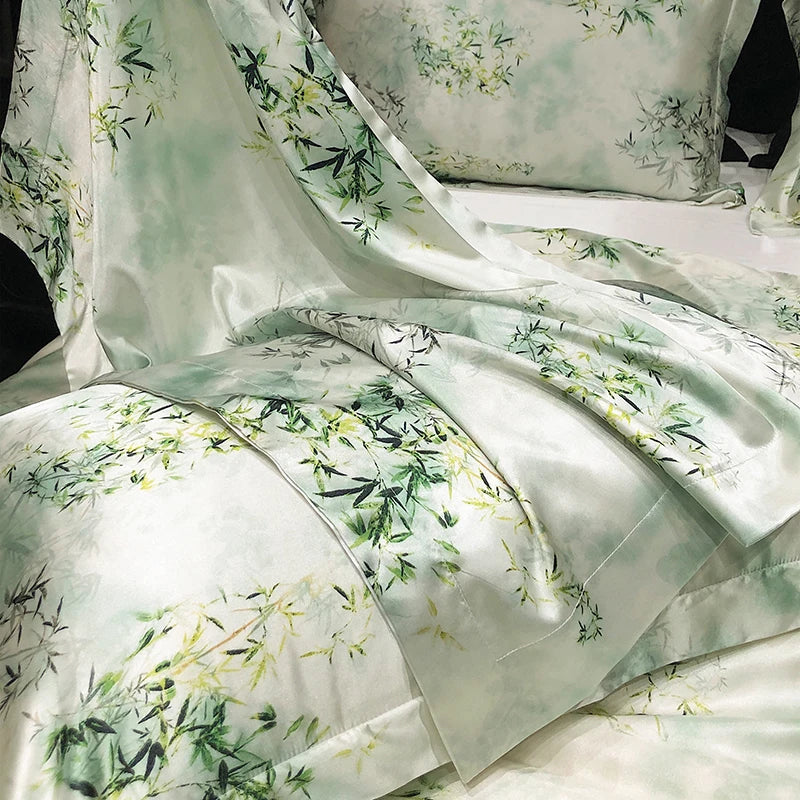
This guide follows cotton through a few important stages, using deliberately simplified examples to explain the terminology. It is not a ranking of sheets or a claim that Daylilt stocks long-staple cotton. The existing Daylilt photograph is bedroom context only; the Moonlit product pictured is described in its current listing as rayon satin, not cotton.
Start with the object being described
Imagine four boxes on a workbench, labelled fibre, prepared bundle, yarn and fabric. A cotton description can refer to any of these levels. A statement about the first box does not automatically describe all the work that happens after it. Likewise, a word attached to the finished fabric does not tell you everything about its original fibres.
This is a useful way to read technical language without turning it into a competition. Put each unfamiliar term beside its object before deciding what it means. Staple belongs beside fibre. Combed belongs beside preparation. Ring-spun belongs beside yarn formation. A weave name belongs beside the arrangement of yarns in cloth. You now have a sequence rather than a collection of impressive-sounding adjectives.
For an original learning exercise, write those four box headings on paper. Whenever you encounter a new textile term, place it provisionally in one box. If you cannot decide, leave it between boxes with a question mark. The aim is not to pretend to be a textile engineer; it is to notice which stage a description actually addresses.
What staple length tells you
The USDA's cotton classing service measures several properties of raw cotton, including length, length uniformity, strength and micronaire, which combines fineness and maturity. Its length measure is an upper-half mean, rather than simply a ruler measurement of one selected fibre. This is crop-level classification information, not a test result for a finished duvet cover. USDA cotton classing services.
Why does a measurement name matter? Consider an invented collection containing eight lengths in arbitrary units: one, one, one, one, three, three, three and three. Its ordinary arithmetic mean is two. Another invented collection containing eight lengths of two also has a mean of two. Yet the two collections plainly have different distributions.
If you select the longer half of the first collection, those four values average three. The longer half of the second collection averages two. This is a classroom arithmetic illustration only, not the USDA's instrument procedure, sampling method or a cotton grade. Its limited lesson is that different summaries can answer different questions about a collection.
It would be a mistake to turn this toy exercise into a prediction about softness. We have not made yarn, woven cloth or tested a sheet. We have merely shown why a statement about a distribution cannot be replaced casually with a statement about one typical strand. That distinction is useful whenever a retail sentence compresses a technical measurement into a short adjective.
Length, type and origin are separate descriptions
CottonWorks identifies Upland and Pima as different cotton species and describes Pima as extra-long-staple cotton. Its explanation also distinguishes geographical names from species: Egyptian cotton refers to cotton grown in Egypt, where more than one species can be grown. Organic describes farming methods rather than a cotton species. These are category distinctions, not guarantees about a finished bedding item. CottonWorks: cotton varieties explained.
Try an entirely fictional supply journey: cotton grown in Country A, prepared and spun in Country B, woven in Country C and sewn into pillowcases in Country D. Four true geographical statements could describe that one item, but each would answer a different question. A country associated with the finished pillowcase would not, by itself, identify where the crop grew.
This imaginary journey is not a description of Daylilt's suppliers or any real manufacturer's arrangements. It illustrates a language problem. When someone says a textile is “from” somewhere, ask yourself which stage that sentence refers to. Crop origin, spinning location and sewing location are not competing versions of one fact; they are potentially different facts.
The same separation helps with type and treatment. A species name is not a preparation step. A preparation step is not a farming method. Keeping those ideas apart lets a description become more precise without adding grander claims. You do not need to assume that an unfamiliar term fills every blank in the manufacturing story.
Carding: preparing a loose collection for the next stage
CottonWorks describes carding as straightening, aligning and cleaning cotton fibres, producing a loose strand called a sliver. Drawing then combines and drafts slivers, improving their alignment and adjusting the bundle's mass per unit length. These are preparation operations; the sliver is not yet the finished spun yarn. CottonWorks: fibre preparation for spinning.
To visualise the difference between a loose collection and an organised bundle, think of laying short strips of paper loosely in a tray, then arranging them to point broadly in one direction. This is an analogy, not a home reproduction of industrial carding. The strips remain separate pieces; their arrangement has changed. A more orderly presentation is different from turning every piece into one continuous strip.
That distinction also explains why “prepared” and “spun” are not synonyms. Preparation gets material into a suitable form for another operation. It does not mean the entire manufacturing sequence has finished. In a recipe analogy, weighing and arranging ingredients matters, but it is not the same event as baking. The analogy concerns sequence, not the physical behaviour of cotton.
Combing: selection is not growth
Combing is an additional preparation operation that removes shorter fibres. CottonWorks explains that the fibres remaining after combing are returned to a sliver for later processing. “Combed” therefore tells you something about treatment of the fibre collection; it does not mean a machine has lengthened every individual fibre. CottonWorks: combing within fibre preparation.
Here is a second invented arithmetic example. Start with five paper strips measuring two, two, four, four and four arbitrary units. Their mean length is 3.2 units. Remove the two shortest strips and the remaining collection has a mean length of four. No strip has grown. The composition of the collection changed because some members were removed.
This is not an industrial combing recipe or a recommended threshold. It isolates the logic of selection. That logic helps distinguish a characteristic of starting material from a characteristic of the material remaining after a process. “Longer starting fibres” and “shorter fibres removed” are different statements even when both appear in the same product description.
Notice what the arithmetic does not establish: how much material a real process removes, what machinery settings it uses, or how any finished sheet performs. Those questions require information beyond the word combed. Our exercise provides a mental picture of the operation, not a substitute for production records or textile testing.
Drawing and drafting: follow mass along a length
Drawing can be easier to picture if you separate the amount of material from the length over which it is distributed. In a purely invented example, imagine a fixed quantity of ribbon occupying one metre, then imagine that same quantity spread evenly across two metres. The amount per metre is now half as large, even though the total quantity has not changed.
Real fibre preparation is not stretching a solid ribbon, and this example deliberately leaves out machinery and losses. It is a way of thinking about linear mass: quantity divided by length. When a technical description refers to making a strand finer through drafting, it is useful to ask which quantity is being held constant and which is changing.
A kitchen comparison makes the mathematical point without claiming textile equivalence. Spread a fixed amount of dough across a larger area and the layer changes; that does not change which ingredients it contains. Similarly, a measurement of material distribution should not be mistaken for a new statement about crop origin. The categories still need to stay separate.
Spinning: forming yarn rather than describing the crop
CottonWorks explains three spinning systems: ring, rotor and air-jet. They organise prepared fibres into yarn differently. Ring spinning uses a rotating spindle; rotor spinning collects fibres in a rotating cup; air-jet spinning uses whirling air currents. Twist and the resulting friction help hold the fibres together. These descriptions concern yarn structure, not the country in which the cotton grew. CottonWorks: yarn spinning.
Do not picture each name as a different cotton plant. Put all three beside the yarn-formation box in the earlier exercise. A process label and a botanical label can coexist because they describe different things. This is why replacing one with the other loses information rather than making a description simpler.
Another useful distinction is between a single yarn and a fabric containing many yarns. A yarn package can be an input to fabric making, not a miniature finished bedsheet. Once you mentally separate the package from the cloth, a phrase about yarn preparation is less likely to become an unsupported statement about the entire finished item.
This guide does not rank spinning systems or assign them a universal comfort order. That would require much more than a process name. The educational point is that there is an actual operation behind the word: a manufacturing choice, applied at a particular stage, rather than an ornamental adjective.
Yarn count: a relationship between length and mass
English cotton count, written Ne, is an indirect yarn numbering system. CottonWorks defines it using the number of 840-yard lengths in one pound of yarn. A higher Ne value describes more length for that fixed mass. This is a yarn specification, not the count of threads in an area of finished fabric. CottonWorks: yarn counts.
Using that definition for a simple calculated example, Ne 10 corresponds to 8,400 yards per pound, while Ne 20 corresponds to 16,800 yards per pound. The second number is twice the length for the same mass. These are arithmetic examples of the unit, not proposed bedding specifications, measurements of a Daylilt product or recommendations to choose one over the other.
The direction of the relationship matters more here than memorising the numbers. In an indirect system, a larger value can mean a finer yarn because more length fits within the same mass. In another measuring system, a larger value may mean more mass per fixed length. Always identify the units before interpreting the direction of a comparison.
Read a manufacturing sentence as a sequence
Consider the fictional description “cotton grown in Region A, combed, ring-spun, Ne 20 yarn”. Read it from left to right as four separate statements: origin, preparation, yarn-forming method and yarn size. The sentence does not become clearer if you collapse all four into “premium”. It becomes clearer when each term retains its own job.
Now remove one term. Without the region, the preparation and yarn statements still have meanings, but crop origin is unspecified. Without combed, the origin does not tell you whether that preparation step occurred. This small editing exercise shows how a description can be partly informative without answering every manufacturing question.
For a final exercise, explain the sentence to another person without using the words luxurious, superior or best. If your explanation still makes sense, you have identified actual information rather than relying on the mood of the adjectives. You have also avoided promising a feel or a lifespan that the fictional sentence never established.
Cotton terminology becomes more useful when it names the material, the operation or the measurement accurately. Staple length belongs to fibres; combing changes the collection through selection; spinning forms yarn; and yarn count expresses a length-to-mass relationship. Keeping those stages visible gives you a clearer picture of how bedding can be made, without inventing the unseen history of a particular product.



Leave a comment
This site is protected by hCaptcha and the hCaptcha Privacy Policy and Terms of Service apply.