

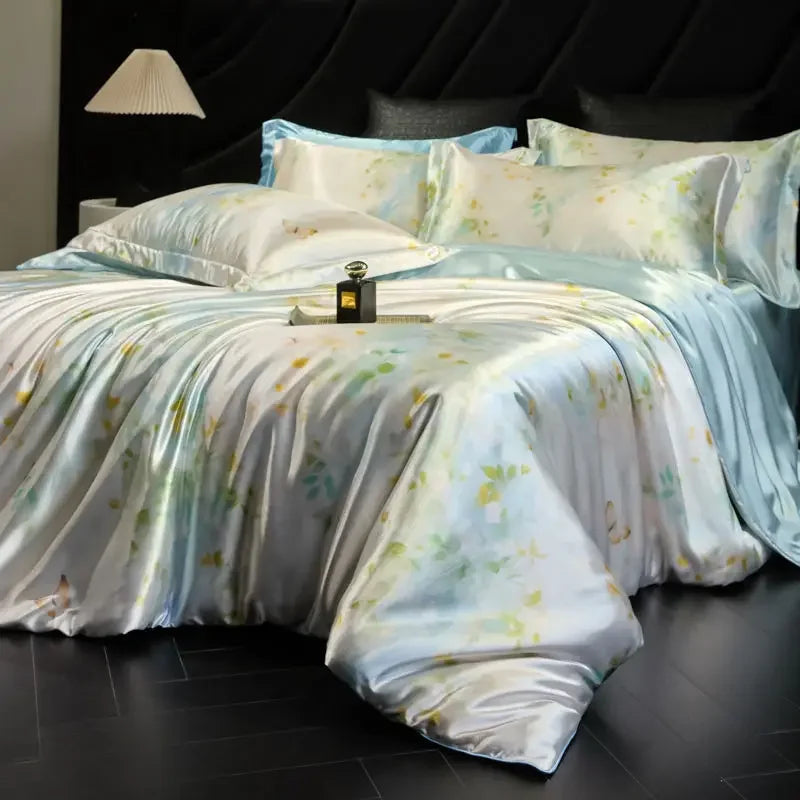
Before buying a bedding set, measure the mattress width, length and depth, then measure the duvet and each pillow separately. Compare those measurements with every piece in the exact product option. A familiar label such as “king” is a starting point, not a guarantee that the sheet, duvet cover and pillowcases will all fit.
A coordinated set can transform the look of a room, but the four pieces do different jobs. The fitted sheet must suit the mattress, the duvet cover must suit the duvet, and the pillowcases must suit the pillows. Getting one measurement right does not automatically solve the other three. This guide gives you a practical measuring worksheet and explains the checks that are easy to overlook when shopping online.
Gather the information before browsing sizes
You need a flexible tape measure, somewhere to record centimetres, and access to the mattress, duvet and pillows. Remove bulky bedding so that you are measuring the items themselves rather than a rounded pile. If you use a topper or protector, keep a note of it: the fitted sheet may need to accommodate the complete arrangement rather than the bare mattress alone.
Photograph any existing size labels as a reference, but do not rely on a faded label or the name on an old order confirmation. Bedding can come from different suppliers, and the duvet may be a different labelled size from the bed. Write down what you have now, not what you remember buying several years ago.
Use separate headings in your notes: mattress, topper, duvet, pillow one and pillow two. Include the units every time. This prevents a common mistake in which the mattress width is compared with the duvet-cover width because both appear beside the same word in a product selector. A few clear labels make later comparisons much easier.
Measure the mattress width and length
Measure straight across the mattress from side to side for width, then from head to foot for length. Keep the tape flat rather than following the curve of rounded bedding. If the mattress has unusual corners or a non-standard shape, note that too. Do not measure the bed frame and assume those dimensions describe the surface the sheet needs to cover.
Repeat the measurements once before writing your final figures. This is especially helpful when the tape is difficult to hold straight across a large bed. If two readings differ, check the start and end points rather than averaging numbers taken in different ways. You want a consistent measurement of the same physical item.
Keep width and length in that order throughout your notes. A rectangle turned around on paper can look like the same size, but a fitted sheet has a particular orientation and corner arrangement. If the supplier uses a different order, translate it carefully and retain their original notation beside your comparison so that the decision remains traceable.
Measure depth with the actual sleeping setup
Mattress depth is the vertical measurement from the underside to the top. If you use a topper under the fitted sheet, measure the combined height at the side without pressing it down. Record the mattress depth and the total depth separately. That distinction helps when the product information describes a mattress limit but your setup includes extra layers.
Read what the listed sheet depth means. It might be a pocket measurement, a recommended mattress-depth range or another supplier dimension. Those are not automatically interchangeable. Ask if the description does not explain how the sheet is intended to tuck under the mattress. Do not invent a universal allowance from the headline pocket number.
A sheet that seems wide enough can still be difficult to fit if the corners do not accommodate the depth. Conversely, extra loose fabric may be inconvenient on a shallower mattress. The aim is a suitable fit for the stated dimensions and construction, not the largest available option. Elastic details and the intended depth range matter alongside width and length.
The duvet needs its own measurements
Lay the duvet out as flat as practical and measure its width and length. Do not use the width of the mattress as a replacement: duvets are intended to extend beyond the sleeping surface, and different households choose different amounts of coverage. If you already like the way your duvet sits on the bed, use that actual duvet as the reference.
Compare those figures with the duvet-cover measurements in the exact option you are considering. A selector may combine a familiar fit label with a specific duvet size. Read both parts. If the cover and duvet differ noticeably, ask about suitability rather than assuming that the shared size name overrides the centimetres.
Also consider closures and any internal fastening details if those affect how you use the cover. Confirm them from the listing or retailer; do not assume they exist because they appear in a different range. A set can be visually right and dimensionally close while still lacking a practical feature you consider important.
Measure the pillows, not their old covers
Measure the pillows themselves using the same width-and-length convention. An old pillowcase may be stretched, shrunk, unusually roomy or designed with a particular closure. It is useful as a comfort reference, but it is not necessarily the right measurement for a replacement. If you use two different pillow sizes, record each rather than assuming they match.
Look at the proposed pillowcase dimensions and closure. An envelope opening, zip or another finish can change how the case is fitted, but it does not remove the need to compare sizes. Do not force a fuller pillow into a smaller case simply because the colour matches the duvet. Ask the retailer if the intended fit is unclear.
The current Daylilt Soft Horizon and Moonlit descriptions list two matching 48 × 74 cm pillowcases per set. Compare that stated size with your pillows. It should not be silently replaced by a generic “standard pillowcase” measurement when choosing the rest of the set.
Read “four-piece” as a contents list

A piece count does not describe the size or type of every piece. Before ordering, write the contents out individually. Are you buying a duvet cover, one sheet and two pillowcases? Is that sheet fitted or flat? Are additional cushions, throws or inserts shown in the photograph included, or are they styling props?
Daylilt's current Soft Horizon description says every option contains one duvet cover, one fitted sheet and two matching pillowcases. The current Moonlit description says every option contains one duvet cover, the selected flat or fitted sheet, and two matching pillowcases. The distinction between flat and fitted is important; the familiar size label does not make those styles equivalent.
Other listings can sell sheets and pillowcase options separately. Do not carry the contents of a four-piece set over to a different product just because its photograph shows a complete bed. Read the individual listing and the final selected variant. The order should describe the pieces you intend to buy, not simply the overall bedroom look you liked.
Flat sheets and fitted sheets require different checks
A fitted sheet has corners intended to wrap around a mattress, so width, length and depth all matter. A flat sheet is a separate rectangle, and you need to consider how you intend to use and tuck it. A flat-sheet measurement that looks generous beside the mattress width does not establish that it will provide the coverage you want at both sides and the foot.
Use an existing flat sheet that you like as a practical comparison. Measure it laid flat and note how you tuck it. Then compare the new sheet's actual dimensions. If you intend to change how the bed is made, consider that explicitly rather than treating the old arrangement as automatic proof that the new one will work.
When a selector offers flat and fitted versions, check that the final selection still has the colour, duvet dimensions and contents you intended. Changing one dropdown can alter another part of the option. Before adding to basket, read the complete variant name again. Taking a screenshot of the confirmed specification can also help you retain a useful purchase record.
Use a simple comparison worksheet
Create six rows: mattress width, mattress length, total depth under the sheet, duvet dimensions, first pillow dimensions and second pillow dimensions. In a second column, record your measurements. In a third, copy the candidate product's exact dimensions and stated fit limits. In a final column, write “matches”, “ask” or “different”, with a short reason.
Keep an “ask” label where a critical measurement is missing. It is better to send a precise question than to guess from a photo. For example: “My mattress including the topper is this deep; does the selected fitted-sheet option support that depth?” This gives the retailer information they can answer without pretending a broad size name settles the issue.
Do not use a total score that allows several correct measurements to cancel out one wrong piece. If the sheet fits but the duvet cover does not, the set still needs another decision. Consider whether another option works, whether you need separate pieces, or whether a different product is a better match. A coordinated appearance is not worth accepting a known fit problem.
A worked example without size-name assumptions
Imagine you measure a mattress at 150 × 200 cm, with a total depth of 30 cm including a topper. Your duvet measures 225 × 220 cm, and both pillows measure 50 × 75 cm. These are illustrative household measurements, not a universal UK size chart and not a statement that any particular Daylilt option will fit.
You would compare the fitted sheet with 150 × 200 cm and the relevant depth information, the cover with 225 × 220 cm, and the pillowcases with 50 × 75 cm. If a listing describes a 220 × 240 cm duvet cover and 48 × 74 cm pillowcases, those differences require consideration even if its selector uses a familiar bed label.
The next step is not to round every number to the nearest size name. Record the exact differences and ask what the supplier recommends for that option. The example shows why a single “king” checkbox cannot replace measuring all the pieces. It also prevents ordering a larger set solely to solve a fitted-sheet-depth question.
Keep appearance and fit as separate decisions
Once the measurements are suitable, choose the colour and print. Verify the selected variant's photograph rather than relying on the first lifestyle image in the gallery. A range may show several colours, and the main image may illustrate a different option. Screens and room lighting can change the appearance of colour, so use the named variant and its associated image together.
Material and care requirements also deserve a separate check. A size match does not establish the fibre composition or washing method. Use the exact product description and supplied label; do not transfer silk-care instructions to every satin or blended item. Keep any unresolved material or care detail as a pre-order question rather than an assumption.
A useful order record therefore contains the product name, complete variant, dimensions, contents, material information and current care guidance. This takes a little longer than choosing from a photograph, but it helps you assess the item when it arrives and reduces avoidable confusion about what you selected.
Check the set when it arrives
Compare the package contents and labels with your order record before use or washing. Follow the retailer's current inspection and returns guidance, and contact them promptly if something differs. Do not assume a wash will correct a known size mismatch. Keep relevant packaging and documentation while resolving any question about the item received.
If the supplied care or dimension information differs from the product page, ask for clarification before proceeding. Product-page descriptions are useful buying information, but an inconsistency should be resolved rather than ignored. When the measurements and contents are correct, follow the supplied preparation instructions and fit each piece without forcing seams or closures.
A well-chosen set begins with six useful measurements. Check the Soft Horizon four-piece set or Moonlit flat and fitted options against your worksheet, and ask about any missing depth or fit detail before ordering. The right colour completes the room; the right dimensions make the set work.



Leave a comment
This site is protected by hCaptcha and the hCaptcha Privacy Policy and Terms of Service apply.