


Before buying something to make a bedroom quieter, describe the sound you want to change: what you hear, where and when, and which part is uncertain. A household routine, a sound within the room and sound travelling from elsewhere can require different questions. Bedding should not be treated as a soundproofing system.
This guide helps you define the problem and decide where to seek an appropriate answer. It does not assess your building, set a safe sound level or recommend construction work, hearing protection or a treatment for sleep difficulties. A useful first result is a clearer brief, not necessarily another product.
Describe the sound without diagnosing the source
Use ordinary words for what you can hear: a repeated click, voices, an intermittent hum or a thump at a particular time. Separate that observation from your assumption about where it begins. A sound seeming to come from one direction is not a professional assessment of its route through a building.
Write the time and the room position where you noticed it, if relevant. Keep an approximate time approximate rather than inventing precision. You do not need technical vocabulary to explain why the sound is inconvenient.
Avoid beginning with a purchase category. “We need acoustic panels” is already a proposed solution. “We hear this at these times and do not know whether it is from this room” gives an appropriately qualified person something more useful to investigate.
Distinguish a routine from an unknown building question
If you know a household activity produces the sound, discuss the timing and practical arrangement first. A cupboard used during another person's rest may be a different problem from an unexplained sound you cannot identify.
Do not presume every sound can be eliminated by asking someone to be more considerate. People may need to work, care for others or use essential facilities. A useful discussion identifies the actual task and possible choices without treating one person's ordinary needs as illegitimate.
For an uncertain source or a suspected equipment problem, use the appropriate responsible person or professional. Do not open appliances, alter fittings or interfere with a neighbour's property to test your theory. Observation should not become an improvised investigation with risks you have not assessed.
Understand two acoustic words before shopping
Sound absorption and sound blocking are not interchangeable product statements. For a technical example, Armstrong's commercial ceiling guidance distinguishes absorption within a space from blocking transmission to adjacent spaces. Its NRC and CAC descriptions concern particular measured properties and systems, not a blanket bedroom promise.
This manufacturer example is not a recommendation to install a ceiling or use a commercial rating to choose bedding. It shows why the word acoustic needs a specific explanation. Ask what a claim measures, in which arrangement and for what actual product.
A material that looks soft does not thereby establish sound insulation for your room. Likewise, a photograph of a layered bedroom cannot show a tested outcome. Keep decorative texture separate from a building-performance claim unless appropriate product-specific evidence genuinely connects them.
Keep the intended outcome specific
Decide what you want the next step to accomplish. You might want to understand an unexplained sound, avoid one unnecessary household interruption or obtain advice about a particular room. Those are more useful aims than a broad instruction to make the whole home silent.
Also identify what must remain functional. The room and building still need their relevant safety, access and operating arrangements. Do not block a vent, modify an alarm or obstruct an opening because it seems to reduce a sound.
This article supplies no design or installation specification. If an outcome requires building work or specialist assessment, use the appropriate qualified professional and permissions. A general online guide cannot inspect your actual construction or certify a proposed alteration.
Notice timing without building a complicated diary
A short factual note can help identify which question to ask. Include the date, approximate start and end where known, what you heard and how it affected the room's intended use. Do not keep recording indefinitely simply because a template has many empty rows.
For an official-process example, Merton Council describes a noise diary as a record of when a nuisance happens and its effect. That is one local process, not a universal legal test or an instruction to use its form wherever you live.
If you need external help, check the current relevant authority or responsible provider's requirements for your own location. Do not assume a homemade recording or a phone-app reading establishes a legal conclusion. Keep the observation useful without claiming expertise it does not provide.
Respect privacy while gathering information
A written account can often describe the question without recording private conversations or filming neighbours. Do not place microphones or cameras in another person's space, publish identifying details or turn the concern into a public accusation.
If a responsible authority or professional asks for particular evidence, follow its appropriate instructions and relevant privacy requirements. Ask when unsure. This guide does not explain recording law or give permission for surveillance.
Keep an observation separate from a conclusion about motive. Hearing an inconvenient sound does not establish that somebody intended to disturb you. A factual account can help the relevant conversation without making it more difficult through an accusation you cannot support.
Review the household task, not only the bedroom
For a known ordinary household source, ask what action creates the inconvenience. A person may need a bag, clothing or work item stored in the room. A different retrieval time or appropriate storage arrangement could be worth discussing without assuming every routine can change.
Keep the proposal specific and mutually understood. “Can this item be collected before this rest period?” is more answerable than “please stop making noise.” Allow the other person to explain a practical dependency you may not know.
If the proposal is unsuitable, look for another appropriate option rather than declaring the conversation failed. The point is to identify a manageable task, not prove that one person should never use part of their home.
Do not make more sound the automatic answer
A product or app marketed for a sound environment still needs its own suitability decision. This article does not prescribe background-noise settings, headphone use or a volume level. Do not assume masking a sound is the same as resolving its source or making the arrangement appropriate.
Consider the people sharing the space and any relevant professional advice. A sound one person prefers may be unwelcome to another. Agree the actual use rather than treating a marketed sleep label as evidence that everyone should accept it.
For a hearing or health concern, seek appropriate clinical advice. A bedroom-shopping guide should not diagnose what you hear or promise that a textile or device treats it. Keep the environmental question separate from an individual healthcare question.
Ask suppliers what their claim covers
If you consider an acoustic product, identify the exact product and proposed use before asking about performance. Request a clear explanation of the measured property, relevant test arrangement and any limitations. A broad percentage without context may not answer your room's question.
Do not transfer evidence from a complete tested system to one visually similar component. Equally, a product's successful use in another type of room does not certify the outcome in your bedroom. An appropriately qualified adviser can explain what information is relevant.
Keep fire, installation, maintenance and other requirements alongside any acoustic statement. An attractive panel or curtain does not become an approved building alteration because you can order it online. The whole application needs to be appropriate.
Check what changed before changing everything
If you can identify when the concern began, note any ordinary change around that time without deciding it caused the sound. A newly placed item, a different household timetable or work elsewhere in the building may be useful context for the responsible person. A coincidence is a question to explore, not a diagnosis.
For a recently purchased appliance, keep its model information and purchase record available when contacting the manufacturer or approved support service. Ask about the actual observation rather than attempting a repair from a video. Do not bypass a safety feature or continue using equipment against its instructions merely to complete a comparison.
If no relevant change is known, say so. An honest unknown is more useful than a confident story constructed to fit a preferred product. You can still describe the timing, location and effect clearly.
Keep bedding in its actual role
A bedding choice can address dimensions, material preference, care or appearance. Those are worthwhile questions on their own. Do not ask a pillowcase or duvet cover to establish room sound insulation simply because the fabric looks luxurious or the photograph feels peaceful.
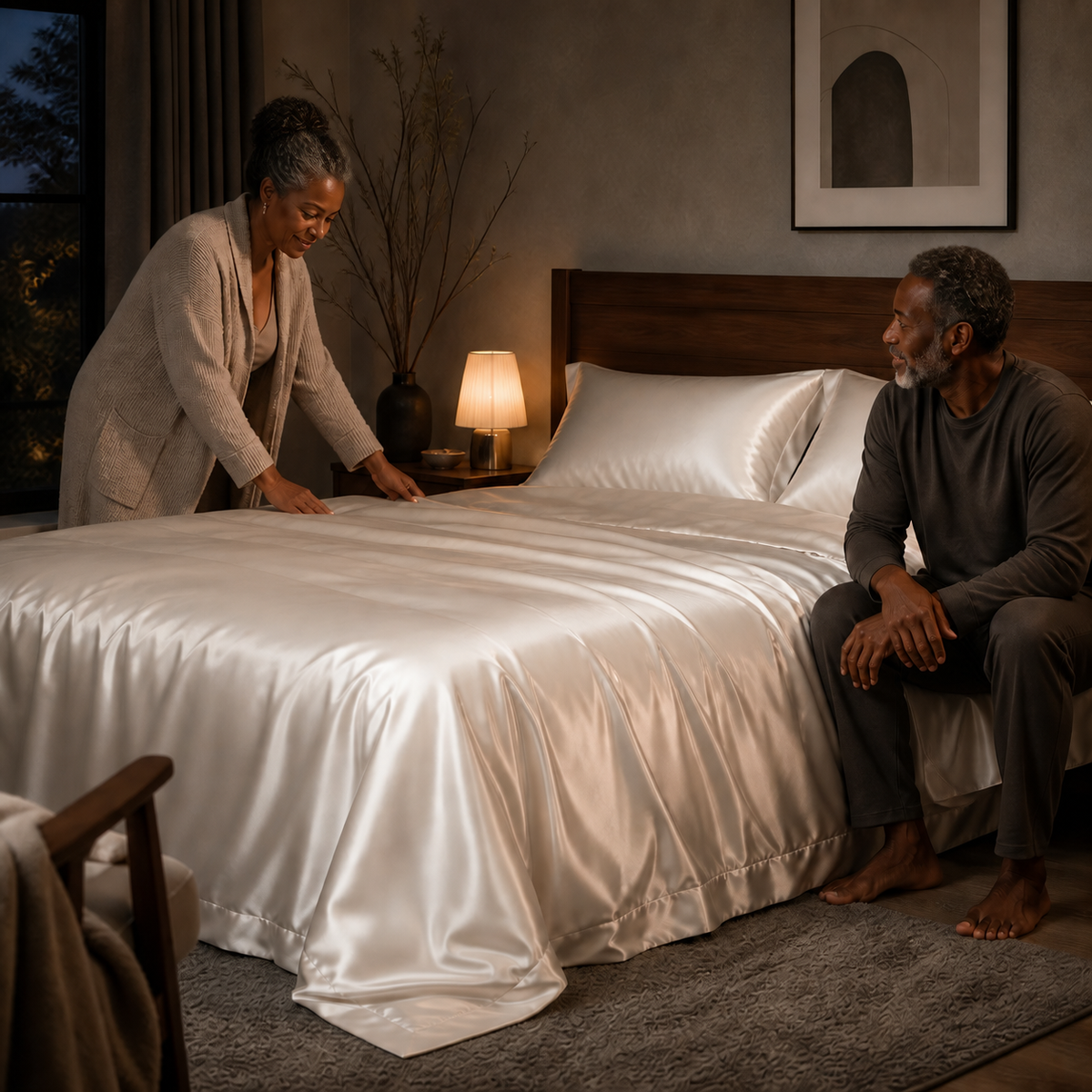
This article's existing Daylilt bedroom image illustrates the brand's bedding appearance. It is not a sound measurement, a quiet-room certification or proof of improved sleep. No acoustic performance is claimed for the pictured set.
If you want to change both bedding and a noise arrangement, separate the projects. You can choose textiles for a clear practical reason while obtaining appropriate advice about another issue. A coordinated shopping basket is not the same as a connected evidence base.
A small question map
| What you know | Useful next question | What remains unproved |
|---|---|---|
| A household task happens at an inconvenient time | Can its timing or appropriate storage arrangement change? | That everyone can avoid the task entirely |
| A sound is heard but its source is uncertain | Who is appropriately responsible for investigating? | Its cause, route or technical remedy |
| A product has an acoustic claim | What property and complete arrangement were assessed? | The outcome in your own bedroom |
| A health or hearing concern exists | Which appropriate clinical advice is needed? | That a bedroom purchase treats it |
This map is a way to avoid answering the wrong question. It does not classify every sound or replace a professional assessment. Use the row that reflects what you actually know, leaving the unknown part visible.
An illustrative household-schedule example
Imagine a fictional shared home where somebody collects work clothing from the bedroom during another person's planned rest. The initial response is to search for products advertised as creating a quiet bedroom.
After describing the actual task, the household discusses an appropriate earlier collection or another storage location. They try an agreed practical arrangement without modifying the building or expecting a new duvet cover to resolve it.
The example does not claim a guaranteed improvement or measured sleep benefit. It illustrates why identifying a known activity can produce a more relevant first question than immediately shopping for a general noise solution.
An illustrative uncertain-source example
Now imagine a person who hears an intermittent hum but cannot identify its source. They make a short factual note and contact the appropriate responsible party or professional. They do not dismantle an appliance or accuse a neighbour based only on the apparent direction.
The next step depends on the actual assessment. It may differ from the product they initially expected to need. Keeping the uncertainty explicit allows the conversation to focus on evidence rather than defend a diagnosis made from a search result.
This is a fictional example, not an inspection of a particular property. No sound level, cause or remedy has been invented. A useful planning guide should preserve those limits rather than offer confidence beyond what it can establish.
Review the chosen action against its real aim
After an appropriate action, ask whether it addressed the task you identified. If not, describe the remaining issue rather than adding unrelated accessories. A clearer record of what changed can make the next professional or household conversation more useful.
Do not label an entire room soundproof from one quieter moment or a personal impression. Keep measured technical claims with the relevant assessment, and describe your own preference as a preference. Those can both be valuable without becoming the same kind of evidence.
Choose the next question before choosing the next product. Describe the sound, separate routine and technical issues, respect privacy and use qualified help where needed. A quieter-feeling bedroom begins with understanding the actual concern, not asking bedding to perform a job it has not been assessed to do.


Leave a comment
This site is protected by hCaptcha and the hCaptcha Privacy Policy and Terms of Service apply.