

Thread count describes part of a woven fabric's construction; it does not, by itself, tell you whether a bedding item will feel right, fit the bed or be worth its price. Read the number alongside fibre, yarn and weave information, and keep your own preferences separate from a claim that a larger number must be better.
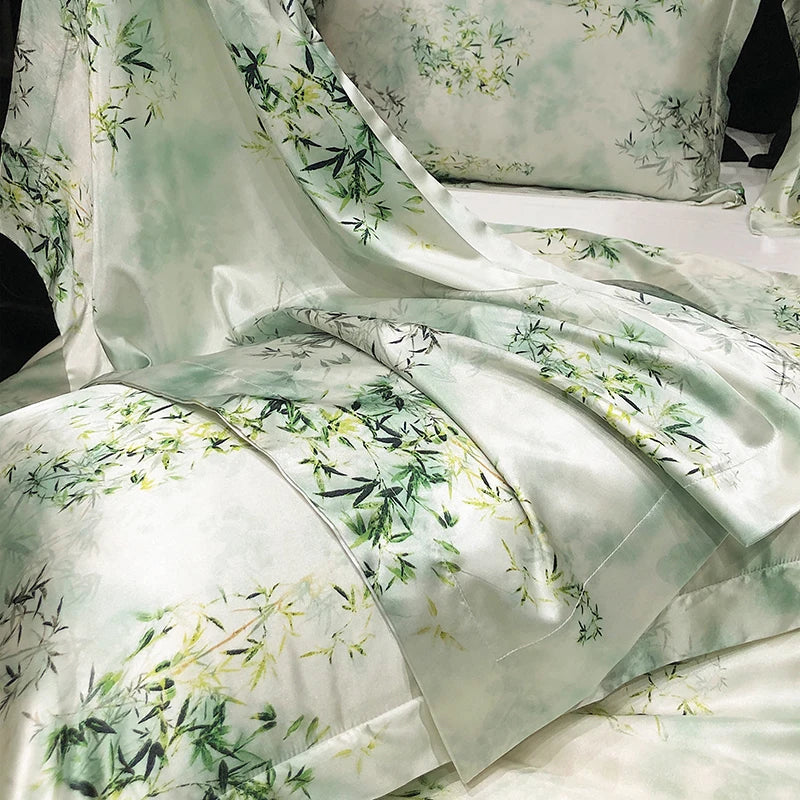
This is textile education, not a new Daylilt cotton collection. The accompanying existing Daylilt bedroom image shows Moonlit rayon satin, not a tested cotton sheet. No thread count is inferred for that product from its photograph. A picture can illustrate a bedroom setting without acting as evidence for a construction measurement.
Start with what is being counted
CottonWorks' construction definition describes the number of warp ends and filling picks in a stated inch or centimetre, often written as two numbers. In ordinary language, those are yarns running in the two directions of a woven cloth. The unit and reporting method belong with the numbers; without them, a comparison is incomplete.
That is a narrower statement than quality. It does not identify the complete fibre composition, tell you how the cloth was finished or establish how you will experience it in your own bedroom. Keep the construction measurement in its proper place. A useful specification answers one question well rather than pretending to answer every question about the item.
Ask whether a listing's thread-count number applies to the exact piece and selected option. A bedding range can contain several constructions, and a made-bed photograph can show pieces not included in the purchase. Do not transfer a specification from a duvet cover to a fitted sheet or pillowcase simply because they share a colour name.
Why the biggest number is not a complete brief
CottonWorks' home buyer guide, published by the cotton industry's research and promotion organisation, warns that advertised counts can be inflated through how multiple yarn strands are counted. It also recommends considering fibre, yarn, construction and finish rather than thread count alone. This is a useful industry explanation, not an independent promise that every cotton product outperforms every alternative.
You do not need to accuse a retailer of misrepresentation because a number looks high. Ask how it is defined and what supporting specification is available. An unexplained figure is an evidence gap, not proof of wrongdoing. The aim is to understand the product, not to turn a shopping comparison into a verdict based on one unfamiliar term.
Likewise, a lower stated count does not prove poor quality. It may describe a different construction or an item intended to have a different feel. Avoid creating an automatic ranking from the numbers before you know whether the fabrics are comparable. A measurement is most useful when you understand both its method and its context.
Keep fibre and weave in separate columns
Write down the fibre composition exactly as supplied. Cotton, linen, silk and rayon are material descriptions, while weave terms describe a different aspect of construction. Do not assume that a smooth or glossy finish identifies silk. Do not compare two thread-count numbers as though the same number makes different materials equivalent.
Then record the stated weave or construction separately. If the listing does not give it, mark that detail unknown and ask if it matters to your decision. Do not fill the gap from a photograph. A close-up may suggest visible texture but cannot certify the complete construction or replace a supplier's specification.
Finally, record any relevant finish information and the supplied care instructions. These should not disappear beneath a prominent number. Your practical decision still needs to account for the maintenance you can provide. A sheet you cannot reasonably care for is not made suitable by a higher count on the packaging.
Ask what kind of feel you actually prefer
People use words such as crisp, fluid, smooth and textured differently. Think about bedding you already enjoy and describe what you like about it without inventing its technical specification. Perhaps you prefer a less glossy surface or a fabric that feels more structured in your hands. That gives the shopping decision a personal reference point.
If a retailer offers a genuine sample or a clear demonstration of the exact fabric, use it appropriately. Ask what the sample represents and whether it matches the current product. A sample from a different range or an old colour collection may not answer your question. Do not assume a sample service exists simply because another retailer provides one.
Where you cannot feel the material before buying, acknowledge that limit. Exact composition, construction information, care guidance and current return terms can help you make a proportionate decision, but they cannot reproduce touch through a screen. You may choose to wait rather than treating a numerical specification as a substitute for every missing detail.
A worked construction example
Imagine an educational sample described as 120 warp ends by 80 filling picks per inch. The two figures describe different directions in the woven cloth. If a supplier reports a combined figure for that same construction, the arithmetic total would be 200. This is a fictional illustration of interpreting a specification, not a measured Daylilt product or a recommendation to buy a particular count.
Now imagine a second sample with a similar combined total but a different distribution between directions. The equal total would not make every construction detail identical. You would still need to understand the actual yarns and fabric. The example shows why preserving the original specification can be more informative than retaining only a single large number.
Do not use the example to count yarns from an online image. A photograph's resolution, angle and scale are not a verified measurement method. If construction evidence matters, request the supplier's actual information. Avoid turning an educational calculation into a home certification test that the image cannot support.
A worked shopping comparison without a winner
Suppose two hypothetical sheet listings show different advertised counts. The first provides composition, weave, exact dimensions and care instructions. The second displays a larger number but leaves several of those fields unclear. You cannot conclude that either is better for your needs from the count alone. The useful next step is to identify the missing information.
Your comparison record might include selected size, fibre percentages, stated construction, counting method if available, care requirements and price for the exact piece. Write unknown where the listing does not answer. Do not manufacture completeness by assuming a familiar brand name or a glossy bedroom image proves the rest.
Once the gaps are resolved, you may prefer either option or neither. A better decision is one you can explain in terms of your requirements, not necessarily the one with the largest specification. The fictional comparison is about method; it does not establish a performance ranking for actual products.
Do not use thread count as a fit measurement
Construction density and physical dimensions answer different questions. Thread count does not tell you the length, width, depth or opening arrangement of the piece. Check those measurements separately against the mattress, duvet and pillows you own. A highly specified fabric can still be the wrong-sized sheet for your setup.
Our bedding measurement guide gives a separate process for the pieces. Keep that record beside the material comparison rather than mixing the two. You should be able to explain both why you chose the fabric and why the selected dimensions match your existing bedding.
The contents need their own check too. A photograph of a complete bed does not establish that the advertised price includes every visible piece. Compare like with like before deciding value. A single pillowcase and a multi-piece set are different purchases even if a construction number appears prominently on both listings.
Read durability claims on their own evidence
If a listing promises a particular service life, resistance to wear or performance after washing, ask what supports that exact claim. Do not treat thread count as proof of all those outcomes. Product construction, use and care belong in the question, and a general fabric description is not a test report for every finished item.
A test needs a clear scope: what sample was tested, under what method and with what result. You do not need to demand a laboratory report for every personal preference, but you should distinguish a specification from a tested performance statement. A chart with no identifiable basis does not become stronger evidence because it uses technical vocabulary.
Keep reviews in context. A reviewer's impression of softness can be useful as an individual opinion, but it does not verify the measurement method or predict your preference. Check the exact product and source rather than relying on a rating that may cover several sizes, materials or unrelated seller experiences.
Do not convert a fabric preference into a sleep claim
You can like a sheet's feel without claiming that its thread count improves sleep or treats a health problem. Those are different statements and need different evidence. Avoid assigning a health outcome to a construction number simply because the product is used in bed. Comfort preferences deserve honest language, not exaggerated promises.
If you have a persistent sleep concern, seek appropriate professional advice rather than continually replacing bedding around a new metric. A product comparison can resolve fit, material or care questions; it cannot diagnose the reason for a health concern. Keep the purchase's job specific enough that you can assess it fairly.
Daylilt's current Moonlit set is described as rayon with a satin weave. That description should not be rewritten as cotton, and its existing image does not establish an unlisted thread count. Accurate education includes being clear about which material and specification a product actually offers.
Keep the retailer question short and precise
A useful enquiry identifies the product, selected option and missing detail. You might ask whether the advertised count is for the selected sheet, what unit is used and whether the stated composition applies to that piece. Avoid asking only whether it is high quality, because that invites another broad adjective rather than a factual answer.
Retain the answer with the order information if you decide to buy. This helps you compare what arrives with what was described. Do not change or wash a new item merely to investigate a mismatch before checking the current support and returns guidance. Ordinary inspection should preserve your ability to raise the actual concern.
If the answer remains unclear, leave the uncertainty visible. You may decide the missing detail is not important to your personal choice, or it may be a reason to postpone. Either is more honest than turning an unanswered question into a positive specification because you are ready to finish shopping.
Keep the unit attached to every number
An inch and a centimetre are different lengths, so a construction figure reported against one cannot simply be placed beside a figure using the other as though the units match. Do not remove the unit to make a comparison table tidier. Keep the supplier's original wording and ask for clarification if the listing changes terminology between sections.
This is particularly useful when comparing products from different markets. The same caution applies to a description using a pair of directional counts and another using a combined headline. Before comparing magnitudes, establish that you understand what each number represents. A mathematically neat table can still be misleading when its columns combine unlike measurements.
If you cannot resolve the reporting method, record the count as not directly comparable. You can still compare confirmed dimensions, composition and care. An honest partial comparison is more useful than an invented conversion that appears precise but answers a different question.
Your construction comparison in seven lines
- Exact piece and selected option.
- Fibre composition and any stated percentages.
- Weave or other construction information.
- Thread-count unit and method, where supplied.
- Physical dimensions and included pieces.
- Finished-product care instructions.
- Remaining question and the source of any answer.
Use thread count as a piece of information, not a shortcut around the rest of the product. Keep the measurement's method, the fabric's identity and your own preferences visible. A clear, comparable specification is more useful than a larger number standing alone.


Leave a comment
This site is protected by hCaptcha and the hCaptcha Privacy Policy and Terms of Service apply.