

A damp or mould concern in a bedroom needs attention as a room or building issue, not a different bedding material. Report what you have noticed to the appropriate responsible person and seek healthcare advice about symptoms. New sheets, fragrance or a dry-looking photograph do not establish that the underlying problem is resolved.
It is understandable to begin with what is closest to you: the bedding, the mattress or the cupboard. Those items may need their own advice, but a shopping decision should not displace a concern about the place where they are used. Keep the room question and the textile question separate so neither is missed.
This guide helps organise that distinction. It does not diagnose a property, specify mould removal, recommend chemicals or equipment, or set legal repair deadlines. Housing processes depend on your location and circumstances; use current local advice rather than transfer an England-specific rule to another jurisdiction.
Recognise the limit of a bedding change
A replacement duvet cover can change appearance, fit or care requirements. It cannot certify the condition of walls, floors, ventilation or another building component. A fabric described as breathable should not be treated as a remedy for damp in the room.
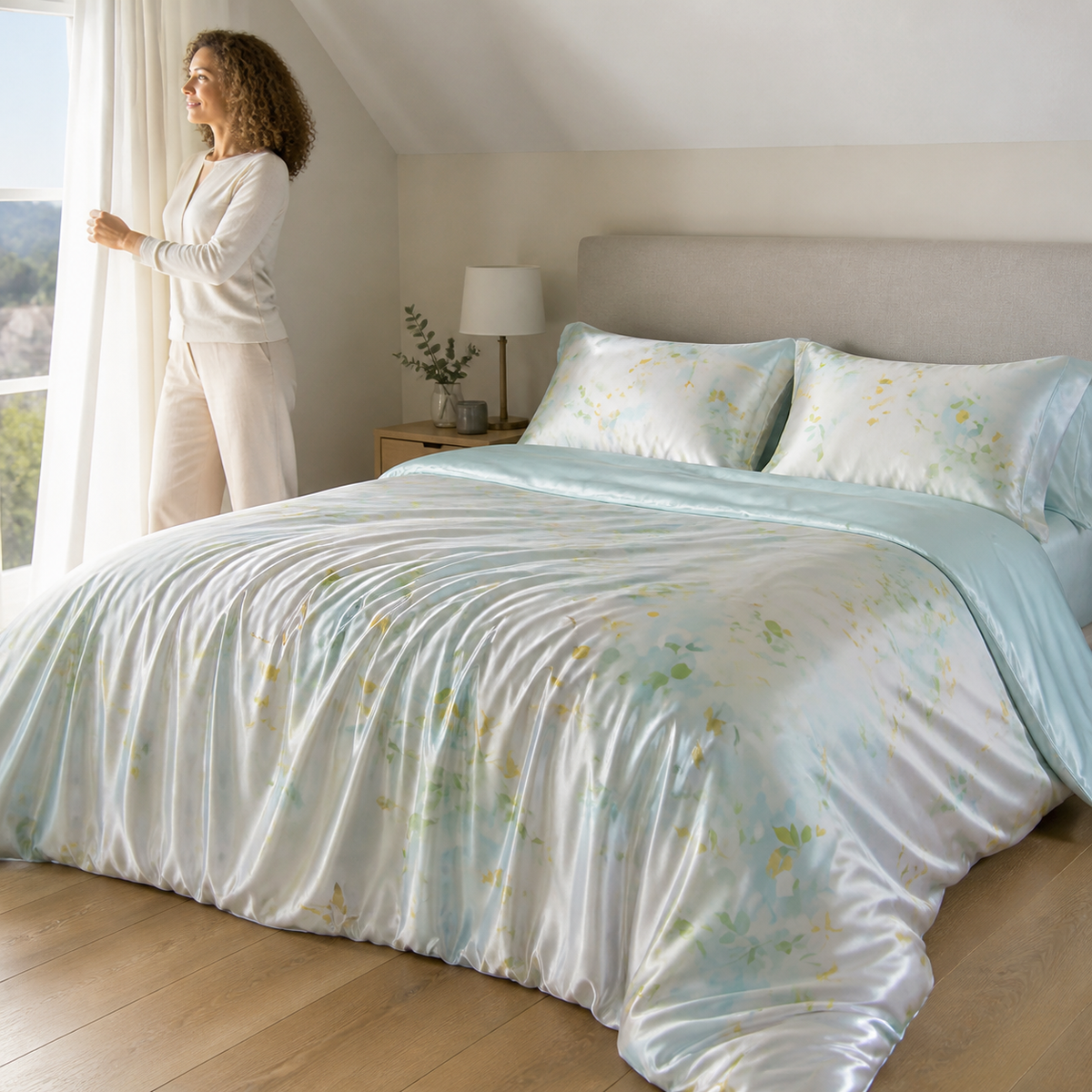
Likewise, a product photograph showing a fresh, tidy bedroom says nothing about your property. Do not conclude that a more luxurious-looking textile would make an environmental concern disappear. The relevant question is what requires assessment, not how to recreate an image.
If an existing bedding item is affected, obtain appropriate advice about that item as well as the room. Do not assume buying a replacement resolves the setting into which the new piece will go.
Use current official guidance for the right place
Government damp-and-mould guidance, updated 1 April 2026, applies to England and is primarily for rented-housing providers. It identifies health risks, calls for prompt attention to underlying causes rather than surface appearance alone, and says ordinary domestic activities should not be treated as a reason to blame tenants.
Those brief points explain why this is not a bedding-upgrade problem. They do not turn this article into legal advice or reproduce the guidance's assessment and remediation procedures. Check the current relevant source for your own housing situation.
If you live elsewhere, find the appropriate local housing or public-health guidance. Do not assume the responsible organisation, statutory process or timescale is identical. A clear report can still describe the concern without making an unsupported legal claim.
Describe what you noticed without choosing the cause
Record the location and your observation in ordinary language. You might have noticed a visible mark, an odour, moisture or a change around a particular area. Say when you first noticed it and whether you know that date precisely.
Keep the observation separate from your theory. A patch near a window does not make you a qualified assessor of its cause. “I noticed this in this place” is enough to start an appropriate report without selecting a technical diagnosis from a search result.
Do not disturb materials, open building cavities or move heavy fixtures to obtain a more impressive photograph. This guide recommends no exploratory removal. Ask the appropriate responsible person how the concern should be assessed safely.
Find the reporting route that actually applies
For rented accommodation, identify the landlord, managing agent or housing provider's current repair-reporting channel. For an owner-occupied property, identify an appropriately qualified professional for the concern rather than rely on a bedding retailer to assess it.
If you are unsure where to report, seek current local housing advice. Keep that question specific: you need help identifying the appropriate route for the property and your circumstances. Do not assume a social-media comment reaches the person responsible for responding.
An immediate emergency or urgent health concern needs the appropriate urgent service, not a routine shopping enquiry. This article cannot decide the severity of your situation remotely. Follow the relevant professional or emergency guidance rather than wait to complete a record.
Make the first report readable
A concise report can include the room, exact area, what you noticed, when you noticed it and any relevant reference from an earlier report. Ask how the concern will be assessed and who will contact you next.
Provide requested photographs through the appropriate channel if it is safe and suitable to do so, but do not assume photographs are a complete inspection. Avoid including unnecessary personal documents or images of other people in the room.
Keep a copy of what you sent and the response. The purpose is to follow the actual concern, not build a public accusation. A clear record can reduce repeated explanations if the issue passes between the provider and a contractor.
A report outline you can adapt
A simple message could say: “I am reporting a damp or mould concern in the bedroom, at this location. I first noticed this on this date, or approximately then. This is what I have observed. Please confirm the appropriate assessment and next contact.”
Add only relevant details you can support. If there is an earlier reference, include it. If you do not know whether the concern has changed, say so instead of inventing a progression to make the report sound more urgent.
This outline is not a legal notice or a substitute for a provider's required process. Use the current applicable channel, and seek independent advice if that process is unclear or the response does not address the concern.
Separate healthcare from property assessment
If you are concerned about symptoms, contact an appropriate healthcare professional. Describe your symptoms and mention the housing concern without diagnosing the link yourself. Medical advice and a property assessment answer different questions.
Do not wait for a bedding purchase to see whether a health concern goes away. Equally, do not claim a new material treats an illness or protects someone from an unresolved environmental problem. This article recommends no therapeutic textile.
Keep health information private and share it through the appropriate professional channel. If another person is affected, obtain their agreement before forwarding personal details. A useful property report does not require publishing a household member's medical history.
Ask what the assessment will cover
When the responsible person replies, clarify which concern the proposed visit addresses. Ask who is attending, what information they need from you and how the next steps will be explained. Do not assume a general inspection includes the exact bedroom area you reported.
If you have practical access or communication requirements, raise them through the appropriate channel. You can ask for an explanation in a usable format without apologising for needing to understand it.
This article does not tell you which test or contractor method to demand. The relevant qualified person should assess the actual property. Your role in this planning guide is to keep your observation and unanswered questions visible.
Do not substitute an unverified treatment
A product sold for cleaning, fragrance, moisture collection or room comfort still has its own instructions and limitations. Do not assume it resolves the particular cause of your concern. Ask the appropriate qualified adviser before treating a purchase as the answer.
This guide supplies no bleach mixture, mould-removal recipe, dehumidifier setting or drying programme for a property. It would be unsafe to prescribe those remotely without knowing the situation. Do not combine chemicals or modify equipment in pursuit of an online tip.
Likewise, do not block a vent, alter wiring or improvise a heating arrangement. A general bedroom article is not an installation specification. Keep any necessary building or equipment work with appropriately qualified people and relevant permissions.
Ask about affected textiles specifically
If bedding, a mattress or stored linen is affected, identify the actual item and obtain appropriate advice about use, handling and care. Keep the sewn-in information available. Do not apply the washing instructions of another product simply because the fabrics look similar.
Tell the adviser what you know about the item and concern, leaving uncertainty explicit. This article cannot assess whether a textile should be cleaned, professionally treated, replaced or handled in another way. It also does not certify that a normal wash makes an affected item suitable.
Where both a property professional and an item manufacturer are involved, keep their roles distinct. One may explain the room assessment while the other explains the product's care limitations. Do not silently treat either answer as covering both questions.
Keep ordinary bedding care separate from remediation
For unaffected items, continue to use their actual care instructions rather than invent an extra-hot programme as a general precaution. A care label applies to that textile; a property problem does not make every aggressive treatment appropriate.
If storage or laundry arrangements raise a concern, describe the actual arrangement when asking for advice. Do not conceal a practical difficulty because a generic guide assumes a different home or available space.
New bedding should be selected for verified dimensions, contents and material information when you genuinely need it. It should not become a way to avoid obtaining an answer about the room.
A two-track record
| Track | Question | Appropriate evidence |
|---|---|---|
| Room or building | What requires assessment and attention? | Observation, report reference and qualified response |
| Affected textile | What advice applies to this actual item? | Product identity, care information and appropriate advice |
| Health | What should I do about symptoms? | Healthcare advice, kept private |
| Follow-up | What remains unresolved after the response? | Specific remaining observation or unanswered question |
The record is not a diagnostic tool or a legal timetable. It prevents one answer from being stretched across unrelated questions. A delivery confirmation for new sheets, for example, does not close a property report.
An illustrative shopping detour
Imagine a fictional customer who notices a bedroom concern and begins searching for bedding described as fresh or breathable. They nearly order a complete new set, hoping a different fabric will solve the problem.
Instead, they separate the tasks. They report the room observation through the appropriate route and ask about any affected item. They postpone a nonessential purchase until they understand what the room and textiles actually need.
The example claims no diagnosis or successful remediation. Its useful result is avoiding the wrong first action: a bedding basket should not take the place of a property or health response.
An illustrative follow-up question
In another fictional case, a visit has happened but the resident does not understand whether the original concern has been addressed. They keep the report reference and ask which work was completed, what remains to be done and how a continuing concern should be reported.
They do not decide that a clean-looking surface proves every underlying issue resolved. Nor do they attempt their own building test to challenge the contractor. They ask for a clear explanation and appropriate independent advice if necessary.
This keeps the discussion about the actual property and response. It avoids both an unsupported all-clear and an unsupported diagnosis made from an online image comparison.
Keep the chronology honest
If you are making a record after the event, distinguish the date you wrote the note from the date you remember noticing the concern. Mark an estimated date as approximate. Do not backdate a photograph or fill missing details from an assumption about when the problem must have begun.
You do not need a perfectly complete history before asking for appropriate help. Send the information you have through the relevant route and explain any gaps. A useful record supports a response; it should not become a reason to postpone one.
Close the right question with the right evidence
When you receive advice or work is completed, check which question it answers. Retain the relevant response and report any remaining concern through the appropriate route. Do not turn a changed appearance into a wider claim than the assessment supports.
The existing Daylilt bedroom image accompanying this guide is decorative product imagery. It is not a damp assessment, evidence of mould resistance or proof that the bedding makes a room healthy. No such performance is claimed.
Treat the bedroom concern as a bedroom concern. Describe it, use the appropriate reporting and professional routes, ask separately about affected textiles and keep health questions with healthcare professionals. Better bedding can be a useful purchase, but it cannot stand in for resolving the room's actual needs.

Leave a comment
This site is protected by hCaptcha and the hCaptcha Privacy Policy and Terms of Service apply.