


A useful bedroom reading corner starts with a place to sit, a usable light and somewhere for the book to go when you are finished. It does not need an armchair, a matching side table and a collection of decorative objects. Choose an arrangement that leaves the bed and the room's ordinary access easy to use.
These are original practical styling ideas, not a promise that reading in a particular place improves sleep. You can enjoy a book because you enjoy it. If your bedroom is shared or has other functions, the corner needs to work with those uses rather than taking them over. Start with what the room can realistically accommodate.
Decide whether you actually need a separate corner
A bedroom photograph may make a reading chair look essential, but the relevant question is whether you would use one. Think about where you already like to read and what is inconvenient there. If the only problem is finding a place for a book and glasses, a new chair may be a larger answer than the room needs.
Write a brief purpose for the arrangement: “I want somewhere to read for a little while without covering the bed in books,” or “I need a clear place to leave my current book.” These are concrete jobs. A vague ambition for a perfect sanctuary can expand into buying furniture that does not solve the original problem.
It is reasonable to decide that reading belongs in another room. A bedroom does not need to perform every comfortable activity. If a separate area would obstruct access or leave no place for clothing, keep the room simpler. Choosing not to add something can be the most considered design decision.
Start with the seat you already use
If you already have a suitable chair, try its ordinary position before shopping. Can you sit there and get up without moving other furniture? Does it become a pile of clothes when not used? Is the place practical when the wardrobe or door is open? Those questions reveal whether the corner is available in real life rather than only after a tidy-up.
Do not assume a decorative chair is suitable simply because it looks inviting. Consider your own comfort and any individual needs. This article does not provide ergonomic or accessibility assessment. Seek appropriate advice where a physical requirement needs more than an ordinary personal preference check.
If you prefer reading in bed, the practical task may be to organise the bedside area instead. Keep items you use within an appropriate reach and avoid unstable piles. Do not buy a second set of cushions or accessories automatically. Start by understanding what supports your existing habit and what is merely making the image busier.
Check the space with furniture in use
Pull the chair out, open the nearby drawer and walk the route to the bed. A corner that fits when everything is tucked away may not work when occupied. Keep necessary paths and exits clear. If the room has accessibility requirements, treat those as essential rather than as a styling compromise.
Measure before adding furniture, but do not reduce the decision to whether its dimensions fit a rectangle. Think about the movement around it and the objects you will place beside it. A small table can still be awkward if it sits where your feet or a door need to go. Practical clearance is part of the arrangement.
Do not use the bed as the storage solution for everything displaced by the reading corner. That only moves the problem to bedtime. Identify a genuine place for clothes, bags and spare bedding before giving their current space another job. If there is no suitable alternative, make the proposed corner smaller or reconsider it.
Give the book an obvious place
Choose one location for the current book, bookmark and any ordinary reading accessories. It might be an existing shelf, a clear part of a table or another suitable surface. The point is that the item can be put down without balancing it on a lamp base or leaving it where someone will step.
Keep the number of books in the immediate area proportionate. A reading corner does not need to become the whole library. If books accumulate because there is nowhere to return them, solve that storage question separately. A small clear surface can be more useful than a large decorative stack that hides the book you actually want.
If two people share the space, give each an identifiable place rather than expecting one pile to remain understandable. You do not need labels on every object, but you do need an arrangement that does not require moving someone else's belongings each time. The corner should support a habit, not create another recurring negotiation.
Assess the light as something you use
Try the existing light from the actual reading position. Can you reach its control, and does its placement work for you and anyone else in the room? Avoid choosing a lamp only because its colour complements the headboard. A beautiful fitting that is awkward to switch on is not answering the practical brief.
If another person is preparing to rest, discuss how the light is used. The relevant question is the specific arrangement, not a general argument about whether reading in bed is allowed. You may choose another position, another time or another room. A shared bedroom needs clear expectations as well as coordinated accessories.
Keep electrical arrangements safe and follow the relevant product instructions. Do not run cables across walking routes, overload sockets or use damaged equipment. If the existing setup is unsuitable or you are uncertain, seek qualified advice rather than concealing a problem behind the chair. This guide does not provide installation instructions or a clinical lighting prescription.
Keep charging separate from clutter
If you use an electronic reader or another device, decide where it will be stored and charged according to its instructions. Do not let the reading corner become a tangle of work and personal equipment simply because it is close to a socket. List what actually belongs there and leave unrelated devices in their appropriate places.
A shared cable may be enough, or a clearer storage arrangement may be needed. Check what you already own and what is suitable before buying more accessories. Do not assume similar connectors make chargers interchangeable. The point is a manageable setup, not a new shopping category for every activity.
Keep work material separate if the room also contains a desk. A personal reading area can become less useful when unfinished papers spread into it. That is an organisation question rather than a failure of the chair or bookcase. Give work a defined place and follow any relevant workplace security requirements.
Style around the room's existing character
Look at the colours and surfaces you plan to keep: walls, bed frame, curtains and flooring. A reading corner can connect to one or two of those elements without matching everything. Use the existing room as the reference. A saved photograph may rely on space, daylight and furniture you do not have.
Choose a limited number of decorative additions only after the practical pieces work. A small familiar object may be enough. Ask whether each addition occupies a space you need for a book, glasses or ordinary movement. Decoration is optional; it should not prevent the corner doing its job.
Do not assume that a particular colour has a universal psychological effect. You can choose it because you like it and it suits the room. Keep the language honest: a palette can look coordinated without being a treatment for stress or a guarantee of good sleep. Personal preference is a sufficient reason when it is clearly described as such.
Use textiles without adding nightly work
A throw or cushion may be enjoyable if it is suitable for the chair and your preference. It also needs a place when not used and a care routine you can follow. Start with existing items where possible. Do not buy several layers simply because the inspiration photograph uses them all.
Keep reading-corner textiles separate from assumptions about bedding. A decorative cover does not automatically have the same material or care instructions as a pillowcase on the bed. Check each item. Matching appearance is not proof that pieces can be washed together or that they serve the same practical purpose.
If you refresh the bed as part of the overall room, compare exact dimensions and contents independently. Our bedding measurement guide is useful for that separate decision. The reading corner should not become a reason to guess the size or fibre of an unrelated purchase.
Keep the room ready for its other uses
Think about when the corner is not being used. Can the chair remain in place, or does it need to move? If it moves, choose a safe, practical arrangement that the responsible person can manage. Do not create a nightly furniture-shifting task merely to reproduce a photograph of a larger bedroom.
If the room becomes a guest room, decide whether the guest can use the corner and where their belongings go. A chair may be more useful as a clear place for a bag during that stay. You can change the room's emphasis temporarily without treating the reading setup as unfinished or wrong.
If pets use the room, consider their ordinary access and keep small reading accessories appropriately stored. Do not make general safety claims about every object or animal. Use suitable household arrangements and seek appropriate guidance where there is a specific concern. A quiet-looking corner still needs to function in the actual home.
An illustrative small-room solution
Imagine a bedroom where a chair already sits beside a wardrobe but is usually covered with clothes. The owner wants a reading corner and initially considers buying a new chair. On inspection, the current seat is suitable; the problem is that clothing has no defined temporary place and the nearby surface is full of unused decorative items.
They organise the clothes elsewhere, clear space for the current book and check the light from the chair. The wardrobe still opens, and nothing needs to be moved onto the bed. They use the arrangement for a representative period before deciding whether any new item is necessary. This is an illustrative design example, not a Daylilt customer account.
The useful result is a room that does more with the existing furniture. If the corner is not used, they can reconsider its purpose without defending an expensive purchase. A small trial keeps the decision connected to daily life rather than to the enthusiasm of saving an attractive image.
Make any purchase answer a missing requirement
If something is genuinely missing, write the requirement first. A stable surface of a measured size or a suitable light with an accessible control is a clearer brief than a luxurious reading corner. Set a budget and check the exact product information. Do not infer safety, fit or comfort from styling alone.
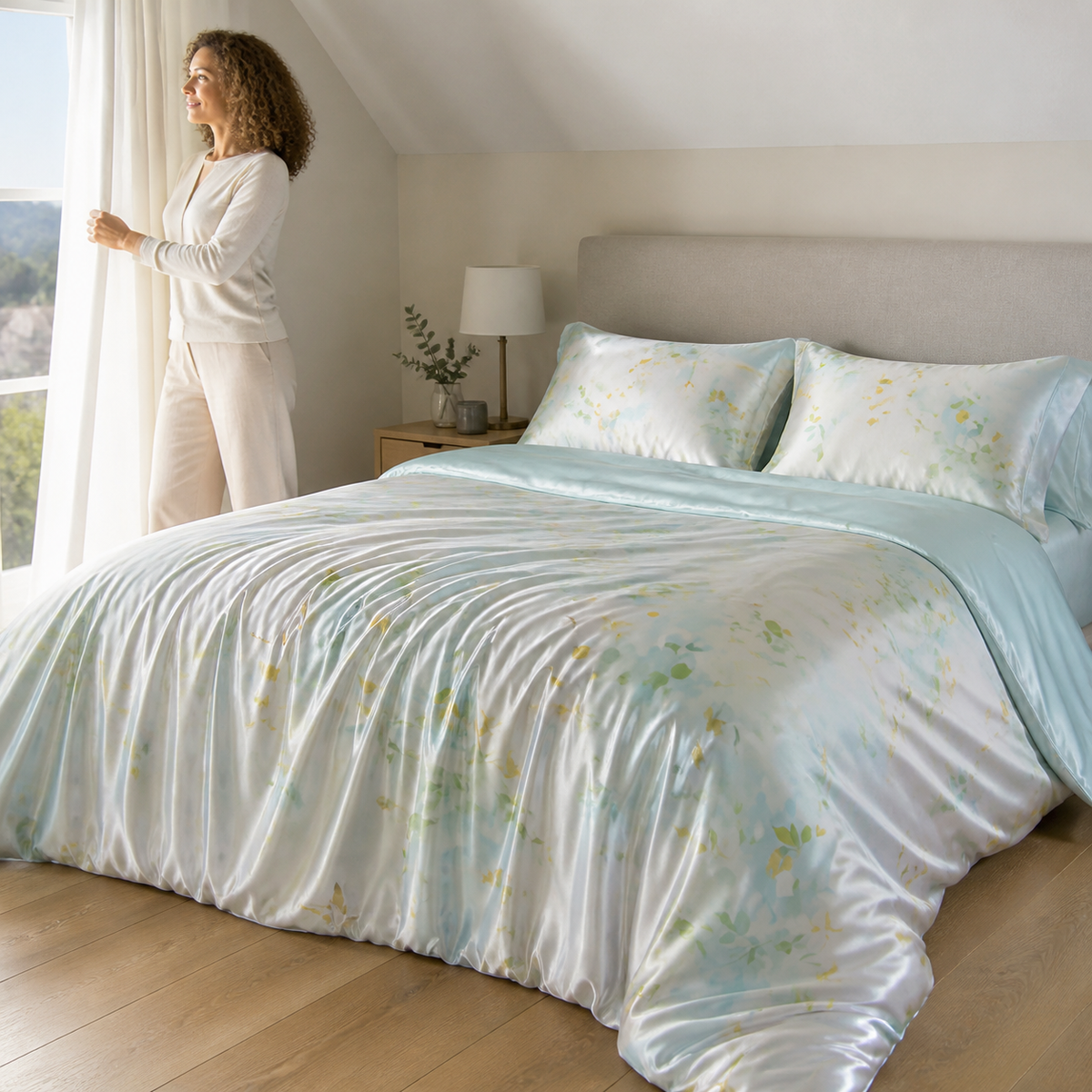
Daylilt's bedroom images can help you consider coordinated bedding around the setting, but they are not evidence of a particular room layout's effect on sleep. The Moonlit Satin Four-Piece Bedding Set is described as rayon satin, not as a reading or relaxation treatment. Choose bedding for verified specifications and personal preference, independently of the corner's practical job.
Keep the final arrangement simple enough to maintain. If a design requires daily clearing of several accessories before you can sit down, ask whether those items belong there. The best reading corner is the one you can use, not the one that needs the most preparation to resemble its inspiration photograph.
Your reading-corner brief
- Name the actual reading habit or inconvenience you want to support.
- Try the existing seat and surfaces before shopping.
- Check access with doors, drawers and furniture in use.
- Give the current book and ordinary accessories a defined place.
- Assess the light and controls from the reading position.
- Keep cables safe and work equipment separate.
- Add textiles and decoration only where they remain practical.
- Review whether the corner is genuinely used before expanding it.
A bedroom reading corner can be modest and still feel considered. Make room for the book, the person and the rest of the household first. Let the styling follow the useful arrangement, and keep reading an enjoyable choice rather than another project the bedroom has to perform.


Leave a comment
This site is protected by hCaptcha and the hCaptcha Privacy Policy and Terms of Service apply.