

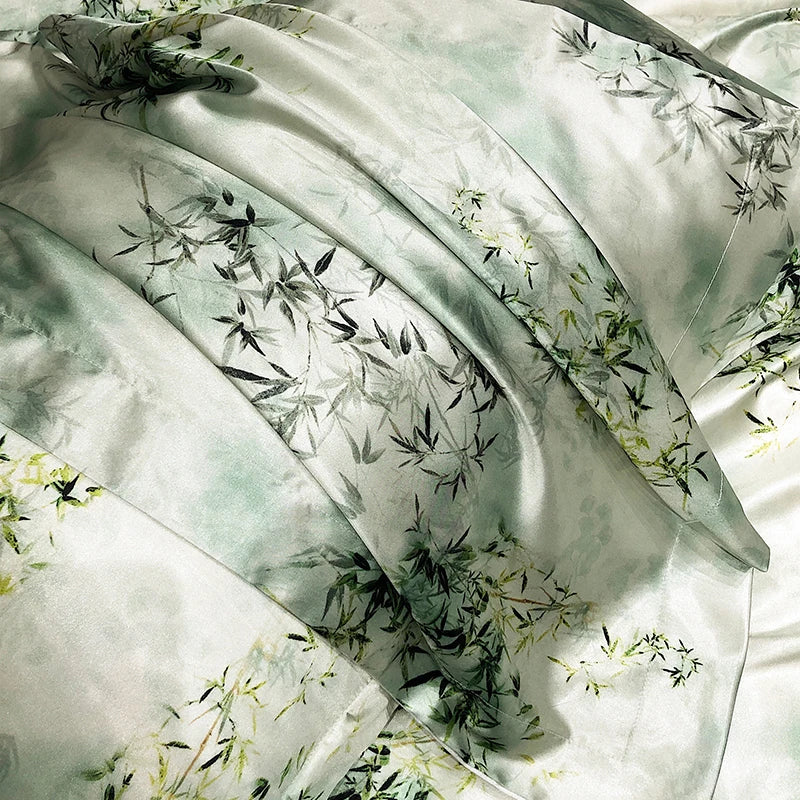
Rayon, viscose and lyocell are fibre terms, not three interchangeable descriptions of a silky finish. They belong to the family of manufactured cellulosic fibres, but the exact name and manufacturing route matter. Understanding those words helps you read bedding descriptions without confusing a fibre, a weave, a plant source and a promise about performance.
This is category education, not a claim that Daylilt stocks every fibre discussed. In particular, it does not establish a Daylilt lyocell range. Use the exact composition and care information for the selected item. A general explanation can clarify terminology; it cannot certify a product's origin, environmental impact, durability or effect on sleep.
Start with cellulose and the word regenerated
Cellulose is a polymer found in plants. The European man-made fibres association CIRFS explains that cellulosic-fibre production commonly starts with cellulose from wood, with cotton linters another possible source. The manufacturing process turns that starting material into fibres; it is not simply a tree being combed into a finished pillowcase. See CIRFS's viscose introduction.
In this context, “regenerated” describes a route by which cellulose becomes a manufactured textile fibre. It does not mean recycled bedding, second-hand material or a fabric that renews itself during washing. Those are separate ideas requiring their own evidence.
That distinction is useful when a product description begins with a botanical story. The named plant may tell you something about feedstock, if documented, but you still need the actual fibre composition. A source story is not a substitute for identifying what the textile is made from.
Viscose identifies a particular process
CIRFS gives the BISFA definition of viscose as cellulose fibre made by the viscose process. Its manufacturing explanation describes cellulose being chemically processed into a solution, passed through fine spinneret openings and regenerated into filaments in a bath. This is a short process overview, not instructions for home manufacture or an account of any particular bedding factory.
The word therefore carries more technical meaning than “soft material from a plant”. It identifies a fibre category associated with a manufacturing route. It does not specify the complete construction of the finished fabric, the maker's quality controls or your eventual care routine.
If a page uses “viscose” only in a long paragraph but gives no clear selected-item composition, ask for the item-level information. You should not have to decide whether a promotional sentence or a label photograph is the intended specification.
Why rayon and viscose can appear in the same conversation
Terminology differs between markets. CIRFS notes that viscose is known as rayon in the United States. The US generic fibre definition for rayon is framed around manufactured regenerated cellulose and includes a defined condition under which lyocell may be used as the description. This explains why an international discussion may use a broader category and a more specific name differently.
For shopping, do not assume that every page using “rayon” has told you the same level of detail as a page naming a particular route. Nor should you infer that two differently worded listings must describe different substances solely from their headings. Ask what the exact selected label says and which term the supplier intends.
This guide is not a legal labelling opinion for a seller. It uses official terminology to explain consumer vocabulary, not to decide whether a particular product complies with every market's requirements.
Lyocell is not simply another word for viscose
CIRFS describes lyocell production as solvent spinning: cellulose is dissolved directly in a solvent system, filtered and formed through spinnerets into water. The solvent is recovered for reuse in the process it describes. The important distinction here is the manufacturing route, not a blanket judgement that every finished lyocell product is better than every viscose product.
The EU textile-fibre definitions in Annex I similarly distinguish viscose-process regenerated cellulose from lyocell's dissolution and solvent-spinning route without derivative formation. You do not need to memorise the chemistry to recognise that these are defined names, rather than interchangeable fashionable spellings.
A fibre definition still does not identify the manufacturer, factory or complete supply chain. If a product makes a specific recovery, sourcing or environmental claim, ask for evidence that applies to that product and claim rather than importing a general process description into the purchase.
Keep fibre and weave on different lines
A bedding description may mention a fibre and a weave together. Those words answer different questions. The fibre is the material category; the weave concerns how yarns are arranged in the fabric. A smooth, shiny appearance does not allow you to work backwards reliably to the exact composition.
Daylilt's Moonlit listing, checked on 17 October 2026, describes rayon with a satin weave. Read both parts: “rayon” is not the same claim as “silk”, and “satin” should not silently replace the composition line. This example is about the published description, not independent laboratory verification.
If you already own another satin item, do not assume the two have identical fibre content or instructions. Use the exact new label. The familiar feel or shine of a finish is useful as a personal preference, not as a composition test.
Separate five layers of information
A helpful way to read a material description is to place its words into five different layers. You do not need every layer to be elaborate, but you should avoid using one as proof of another.
- Feedstock: the documented starting source, if the seller makes a claim about it.
- Fibre: the actual named composition of the selected textile.
- Fabric construction: the relevant weave or other construction information.
- Finished item: the component, measurements, closures and other practical details.
- Use and care: the supplied instructions and any properly supported specific claims.
A story about the first layer does not complete the remaining four. Likewise, an attractive finished photograph cannot establish the upstream source. Keeping the layers separate makes a description easier to understand without needing to become a textile specialist.
Do not transfer a process fact into a product promise
A general manufacturing description can be accurate while still being insufficient for a particular commercial claim. For example, learning that a process involves solvent recovery does not establish the measured environmental impact of a finished bedding set. The item has further stages, components and circumstances that the short definition does not cover.
Ask which product the claim applies to, what was measured and what comparison is being made. A statement about a named fibre manufacturer's process should not automatically be extended to every textile using the same generic fibre name. Equally, lack of product-specific evidence is not permission to declare the opposite conclusion.
This is a boundary on inference, not a verdict against a fibre. You can choose a material for documented composition, appearance or practical requirements without inventing a wider sustainability story to justify the purchase.
Comfort preference is a different question again
You may like a particular surface feel and still need to check fit and care. Someone else may prefer another texture. Neither preference changes the fibre definition. Avoid turning personal enjoyment into a universal rule about which bedding everyone should use.
A fibre name by itself does not prove that a product treats insomnia, protects skin, prevents hair damage or solves a medical concern. Ask for specific evidence for a specific claim, and seek appropriate professional advice for personal health questions. A material glossary is not a medical recommendation.
When discussing comfort, describe what you can actually establish: the selected construction, the appearance shown and your own preferences. Leave unmeasured outcomes unclaimed rather than borrowing scientific language to make an ordinary bedding choice sound like a treatment.
Care belongs to the whole selected item
Do not assign one washing routine to every product described as rayon, viscose or lyocell. Read the exact supplied care information, including the requirements of the complete item. Ask the seller before use if instructions are missing or inconsistent.
A familiar fibre term is not permission to copy the process used for another sheet. Closures, finishes and the rest of the construction belong to the actual product you will handle. This article intentionally supplies no universal temperature, drying method or shrinkage allowance.
Use the care information supplied with the item to organise your questions. Understanding the material name helps you read the description, but the item's own documented instructions govern how you care for it.
Compare two descriptions without ranking the words
Imagine two fictional listings. One states “viscose pillowcase” and gives clear dimensions and care. The other says “plant-based luxury bedding” but does not provide a clear composition for the selected option. The second phrase is more decorative, yet the first provides more useful information about the fibre.
That does not prove that the first product is better made or more suitable. It means you have a clearer starting specification. Ask the second seller for the missing composition before comparing the items further. Do not fill the gap with the material you hoped the phrase meant.
In a second fictional comparison, one listing names lyocell and another names rayon. Before choosing, establish the actual components, fit, construction, care and relevant evidence. You are comparing finished items, not awarding a prize to whichever fibre word currently sounds more premium.
A short material-reading worksheet
Write the exact wording rather than a translation into your preferred term. Keep the selected product link and variant so the note refers to one item, not an entire collection.
- Composition wording: what does the exact label or specification say?
- Source claim: is a plant, manufacturer or supply-chain claim separately documented?
- Construction: which words describe weave or finish rather than fibre?
- Practical fit: what component and measurements are selected?
- Care: are the complete instructions available and workable?
- Open question: which missing answer would change your choice?
Leave percentages and detailed blend comparisons to the exact composition information rather than guessing them from the first word in a title. The worksheet is meant to clarify categories, not calculate an unsupported quality score.
Questions that help a seller answer precisely
Instead of asking whether a material is “good”, ask which fibre name appears on the selected item's label and whether the online description uses an alternative market term. If a named plant is prominent, ask how that statement relates to the finished composition. If a claim matters, request its product-specific scope.
For a satin item, ask about the composition and care without treating satin as the answer to both. For a set, check whether the specification applies to every component. Keep the question narrow enough that the seller can respond about the item rather than send another general fibre article.
If the information remains unclear, waiting or selecting a more clearly documented option is reasonable. You do not need to buy first in order to deserve a comprehensible explanation.
Annotate a description before comparing it
Take this invented sentence: “A botanical-inspired satin pillowcase in a calming blue.” It contains a design association, a construction word, a component and a colour description, but no explicit fibre composition. Writing “viscose” beside it would add information the sentence did not provide. The appropriate next step is to find the composition line or ask for it.
Now consider: “A rayon satin pillowcase, sold singly.” This gives a fibre term, a construction term, the component and quantity. It still leaves the dimensions, selected colour, care and any more specific process information to be checked. Neither sentence establishes a clinical benefit or a quantified environmental comparison.
This annotation exercise is useful because it rewards clarity rather than dramatic language. You can recognise what a description does tell you while identifying what remains unanswered, instead of treating every missing detail as either proof of quality or proof of a problem.
Use the terminology, then return to the bed
The useful distinction is straightforward: regenerated cellulosic fibres are manufactured from cellulose, viscose and lyocell identify different defined routes, and rayon's use needs its market context understood. None of those names alone completes a finished bedding specification or proves a health or environmental outcome.
Choose around the actual product: its documented composition, construction, fit and care, plus your preferences and any evidence relevant to a particular claim. Knowing the words should make the choice clearer, not create a new reason to trust an unsupported promise.

Leave a comment
This site is protected by hCaptcha and the hCaptcha Privacy Policy and Terms of Service apply.