


Linen is a flax-based textile worth considering when you like a more textured appearance and want to compare breathability, moisture handling and care in the exact fabric you will buy. Its advantages are not a guarantee of better sleep, and “natural” does not tell you whether a particular sheet will fit, feel right or suit your laundry routine.
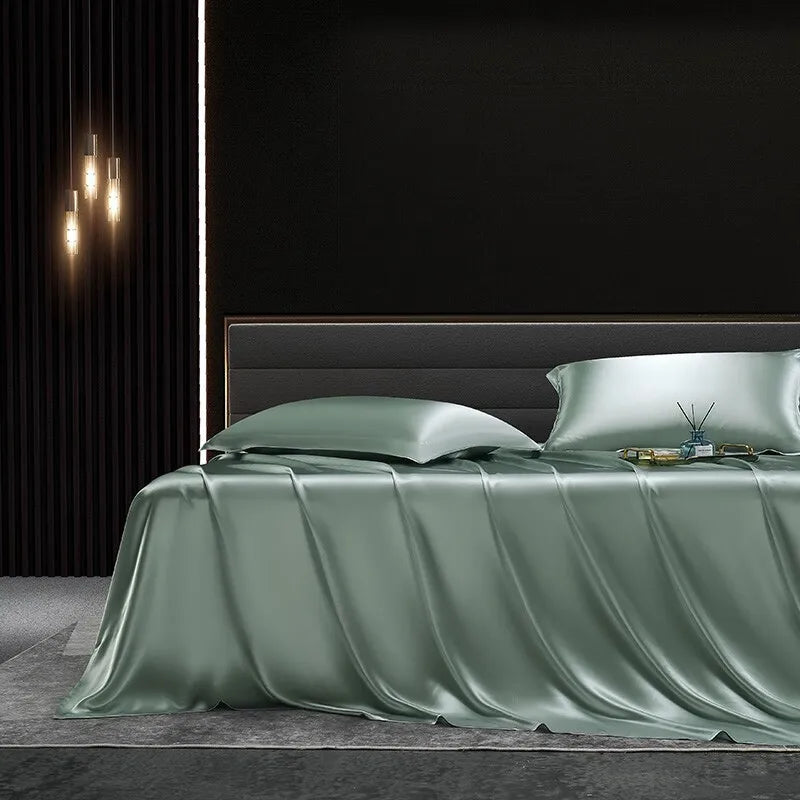
This is material education, not a new Daylilt product announcement. The current Daylilt catalogue checked on 17 October 2026 did not contain a verified linen product. The accompanying existing Daylilt bedroom image shows rayon satin bedding, not linen. We use it to illustrate a bedroom setting only, so the image should not be read as a linen sample.
Understand the material claim before the aesthetic
The Alliance for European Flax-Linen & Hemp, a sector organisation, describes flax as the fibre behind linen and reports commissioned laboratory comparisons examining air permeability, water-vapour transfer, absorption and insulation. Those are useful fabric properties to investigate. The page is industry-funded evidence about tested samples, not an independent clinical guarantee for every finished bedding product or a particular person's sleep.
Begin with the composition label. Is the item described as 100% linen, or is linen one part of a blend? If it is blended, ask for the fibre percentages rather than assuming that the name describes the whole material. The proportions matter when comparing two listings. A prominently displayed word can be a useful clue, but it is not the same as a complete specification.
Keep fibre, construction and finish separate in your notes. A material name does not tell you every detail of how the cloth was made or treated. A weave description does not identify the fibre by itself. This is especially important when comparing linen with satin: satin is a weave description, while linen identifies a flax-based material. They are not interchangeable categories on a shopping checklist.
Translate potential benefits into useful questions
Instead of writing “linen is best,” write what you want from the bedding. Perhaps you prefer a less glossy surface, want to explore a different texture or are interested in a fabric's moisture handling. That gives you a question to ask of the exact item. You can compare evidence for that question without needing one material to win every category.
For breathability, ask whether the retailer provides relevant information about the finished cloth rather than only general fibre marketing. For moisture handling, ask what the claim refers to and whether there is a test or specification behind it. A test result for one sample cannot automatically be transferred to a different blend, finish or fabric construction.
For appearance, use actual product images and, where available, a physical sample. A photograph can show styling and visible texture, but it cannot recreate touch or establish comfort. Keep “I like this look” as a valid personal reason without converting it into a health statement. A choice can be attractive and practical without being described as a cure for anything.
Texture is a preference, not a quality verdict
People use words such as crisp, smooth, relaxed and textured in different ways. Before relying on a review, ask what the reviewer is comparing with. Someone moving from a glossy satin surface may notice something different from someone who already uses a textured cloth. Neither observation tells you exactly how your own hands will interpret the material.
If a sample is available, compare it in a consistent way with something you already own. Look at it under your normal bedroom lighting, feel it with clean hands and read the accompanying material information. Do not wash a sample or an item unless you understand the seller's instructions and applicable return conditions. A careful comparison should not accidentally remove your options.
If samples are not available, acknowledge the limit. Ask for a clear description and exact composition rather than demanding a promise that it will feel “luxurious.” Keep your decision proportionate to the uncertainty. It may be sensible to postpone a larger order, especially if your preference is very specific and the listing gives little useful information.
Decide how you feel about visible creases
Some people enjoy a relaxed, visibly lived-in bed; others prefer a smoother presentation. Decide which appearance you want before buying around a mood board. Do not assume that a styled photograph shows how the item looks after an ordinary night in your home. Ask whether the image represents the exact product and what preparation was used.
A crease should not automatically be treated as proof of poor quality, and a perfectly smooth image should not automatically be treated as proof of better quality. Appearance is only one part of the assessment. Check fit, closures, composition and care as separate matters. If a finish is important to you, ask a precise question rather than interpreting the photograph as a guarantee.
Think about how much work you actually want to put into presentation. If you dislike ironing, choose around that preference and the supplied care instructions. Do not buy a look that requires a maintenance routine you already know you will resent. Equally, if you enjoy a more tailored bed, be honest about that rather than assuming you ought to prefer a relaxed style.
Read care instructions before choosing
Do not infer a washing temperature, drying method or ironing setting from the material name. Read the exact product label and retailer guidance. Dyes, trims, closures and finishes can affect the instructions for a finished item. A general article about linen cannot replace those instructions or establish that all pieces in a set can be cleaned together.
Compare the care requirement with your actual equipment and drying space. If an item requires a process you cannot reasonably provide, that is a practical mismatch even if you like the fabric. Ask questions before ordering rather than buying first and hoping the care label will be convenient. A manageable routine is part of long-term value.
Keep the instructions somewhere accessible. A photograph of the label or a link saved with the order can help you identify the right guidance later. Do not combine advice from unrelated items simply because they all contain linen. If the supplied information is contradictory, ask the retailer to clarify it and retain that answer.
Check the blend and finish without making assumptions
A linen blend may have a reason for existing, but the blend name alone does not tell you its performance. Ask what fibres are included, in what proportions and what the retailer can verify about the finished product. Compare those details with your preferences. Avoid a blanket rule that every blend is inferior or every pure-fibre item is automatically better.
Likewise, words such as softened, washed or premium need context. What process or specification does the retailer mean? Does the description apply to the exact product you selected? A clear answer is more valuable than a string of adjectives. Leave an unsupported attribute undecided rather than filling the gap with an assumption drawn from a different brand.
Be cautious about promising how a fabric will change over time. Your care, use and the actual construction matter. A retailer may provide relevant guidance, but a lifestyle article should not guarantee that an item will become softer after a certain number of washes or last a particular number of years without appropriate product-specific evidence.
Keep sustainability claims specific
A natural fibre label does not settle the environmental question for a whole finished product. If sustainability is part of your decision, look for precise claims with a clear scope. Does a certification concern fibre origin, processing, harmful-substance testing or something else? Those are different subjects. Ask which standard applies and to which part of the item.
Check that certification information refers to the product or supply chain being offered rather than appearing as an unrelated logo. If a number or verification route is provided, use the issuer's official information to understand it. Do not assume that a certification proves every environmental or social claim you might associate with the material.
Also consider your own likely use. A well-chosen item that fits and is cared for according to its instructions is a more meaningful purchase decision than a material you buy for a slogan and leave unused. This is not a quantified environmental comparison. It is a practical reason to check need, fit and maintenance before adding another set.
Compare complete products, not isolated fabric names
Write down the actual dimensions, contents and closure details alongside the material. A duvet cover and two pillowcases are not equivalent to a set that also includes a sheet. A familiar bed-size label is not enough to establish that all the pieces fit. Use exact measurements for the mattress, duvet and pillows you own.
Price comparisons need the same discipline. Compare like with like: the selected size, number of pieces, composition and relevant care or delivery conditions. A lower headline price may refer to a single pillowcase, while the photograph shows a whole bed. Do not let the image decide what is included. Read the selected option before drawing a value conclusion.
Our bedding measurement guide gives a separate worksheet for fit. Use it regardless of the material you choose. Linen cannot compensate for a cover that does not match the duvet, and a satin finish cannot correct a fitted sheet that is too shallow. Material and fit are independent decisions.
An illustrative comparison without a winner
Imagine you are comparing a linen sheet with a rayon satin sheet. This is an educational example, not a claim that Daylilt stocks both. You prefer the textured appearance of the linen photograph but like the smooth look of the satin. You record both reactions without deciding that either one proves superior sleep or better quality.
You then compare composition, exact dimensions, care instructions and the availability of reliable sample information. One listing has missing sheet-depth information, so that option remains open while you ask the retailer. The other fits the stated dimensions but requires a care routine you need to consider. Neither decision can be made from the fibre name alone.
The useful outcome is a reasoned shortlist: which item answers your priorities, which uncertainty remains and what would resolve it. You might choose either material, choose neither or keep the bedding you already have. A comparison is successful when it makes the decision clearer, not when it produces a compulsory purchase.
Where Daylilt fits in the comparison
Daylilt's current Moonlit Satin Four-Piece Bedding Set is described as rayon with a satin weave. It is not a linen alternative presented as the same material. Its current product photograph can help you consider a glossy, coordinated look, but it does not illustrate linen texture or establish how another fabric would feel.
If you are specifically seeking linen, do not order a silk-blend or rayon satin item on the assumption that the names are interchangeable. Read the composition and ask about missing details. We can discuss different materials without pretending that every material is already in the catalogue. Educational content should make that boundary clearer, not hide it.
Equally, choosing a non-linen material is not a failure to select the “best” bedding. Your preferences, dimensions, care routine and budget all belong in the decision. The purpose of learning about linen is to understand its potential properties and trade-offs, not to replace one set of marketing assumptions with another.
Your linen decision checklist
- Confirm whether the composition is linen or a blend and record the percentages.
- Separate fibre, construction, finish and appearance in your comparison.
- Translate breathability or moisture claims into questions about the exact fabric.
- Decide whether the texture and visible finish suit your preferences.
- Read the supplied care instructions before ordering.
- Check certification scope rather than assuming a broad sustainability guarantee.
- Compare dimensions, contents and the selected option independently of material.
- Keep sleep or health claims separate from a personal comfort choice.
Linen can be an interesting material choice without being a universal answer. Learn what the exact product contains, what evidence supports its claims and how it fits your room and routine. A precise comparison is more useful than calling any fabric the best for everyone.

Leave a comment
This site is protected by hCaptcha and the hCaptcha Privacy Policy and Terms of Service apply.